
Quantum Entanglements
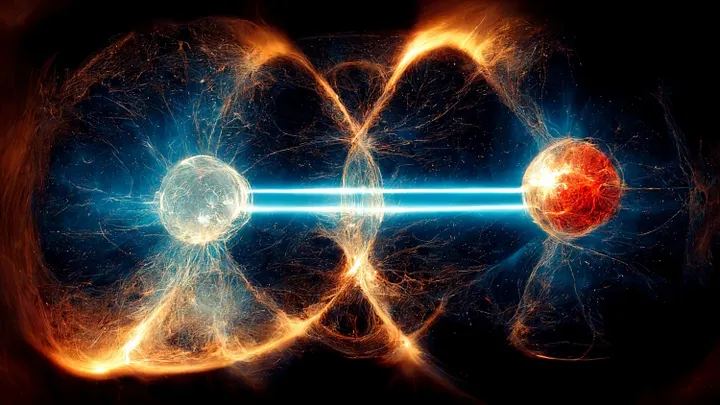
Quantum entanglement is a phenomenon in which two or more quantum systems become correlated in such a way that the state of one system cannot be described independently of the others, even when the systems are separated by large distances. In other words, the properties of one system are dependent on the properties of the other system, even if they are not physically connected.
One of the most famous examples of quantum entanglement is the Einstein-Podolsky-Rosen (EPR) paradox, which was proposed in 1935. The EPR paradox involves two particles that are created at the same time and place, and then travel in opposite directions. According to quantum mechanics, the properties of these two particles are entangled, meaning that the state of one particle is dependent on the state of the other, even if they are separated by a large distance.
This phenomenon has been experimentally verified in a number of ways, including through the use of particles such as photons and electrons. In addition, quantum entanglement has been proposed as a possible means of creating secure communication channels and for use in quantum computing.
However, the phenomenon of quantum entanglement still remains a subject of debate and active research in the field of quantum mechanics, as it seems to defy our classical understanding of reality and raises questions about the nature of reality itself. Some scientists and philosophers argue that the entanglement of two particles implies that they are connected in some non-physical way, and that this non-physical connection may be the key to understanding the nature of reality.
Overall, quantum entanglement is a mysterious and fascinating aspect of the quantum world that has yet to be fully understood, but its potential implications in areas such as communication and computation make it an active area of research.



0 Comments